


In the modern data-driven enterprise, the abundance of information has created a paradoxical challenge. While organizations have more data than ever before, they often struggle to agree on what that data actually means. It is a common occurrence in boardroom meetings for the marketing department to present one figure for “Customer Acquisition Cost” while the finance department presents another, even though both teams are looking at the same underlying database. This discrepancy is the “metric consistency problem,” and it stems from the fragmentation of logic across various business intelligence tools and data silos. The emergence of the semantic layer is providing a definitive solution to this chaos, acting as a universal translator that ensures everyone in the organization speaks the same numerical language.
Understanding the Metric Consistency Problem
To appreciate the value of a semantic layer, one must first understand the structural flaws in traditional data architectures. Historically, data was extracted from source systems, cleaned in a data warehouse, and then pushed to various Business Intelligence (BI) tools. The problem arises because the “logic”—the mathematical formulas that define a business metric—is usually embedded directly within the BI tool itself.
If an organization uses three different BI tools for different departments, they must define a metric like “Gross Profit” three separate times. If one analyst decides to include shipping costs in that calculation while another does not, the resulting reports will never align. This leads to a breakdown in trust. When stakeholders spend more time arguing about whose data is correct than they do making decisions based on that data, the entire value proposition of data analytics is undermined.
What is a Semantic Layer
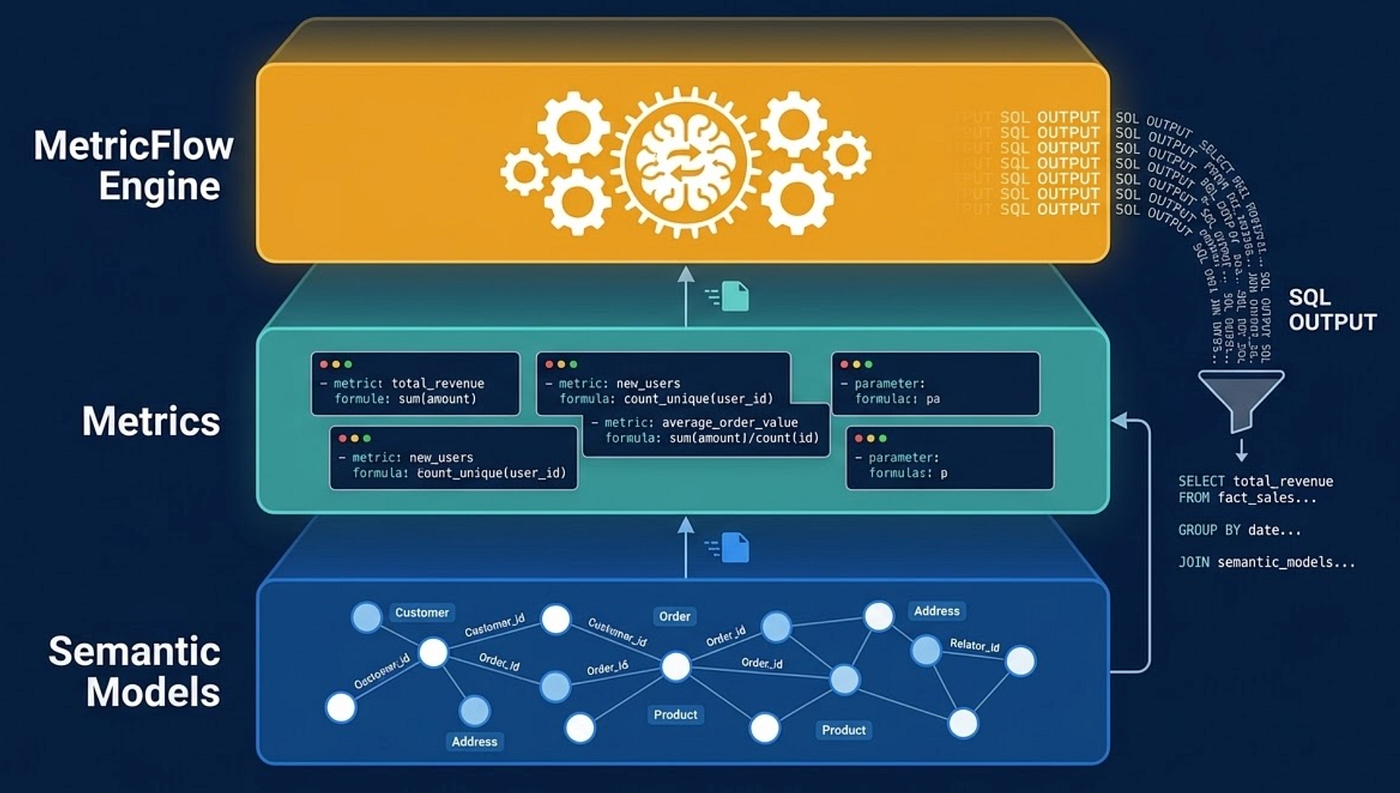
A semantic layer is an abstraction layer that sits between the data storage (such as a cloud data warehouse like Snowflake, BigQuery, or Databricks) and the consumption layer (BI tools, AI models, and spreadsheets). Instead of defining metrics in each individual application, the logic is defined once in the semantic layer.
Think of it as a “source of truth” for definitions. It maps complex technical data structures—like table joins, foreign keys, and SQL aggregates—into business-friendly terms. Instead of a user needing to know how to join a “Sales_Fact” table with a “Product_Dim” table and filter for “Tax_Exempt_Status,” they simply drag a field called “Net Revenue” into their report. The semantic layer handles the underlying technical translation, ensuring that the calculation for “Net Revenue” is identical regardless of which tool is used to access it.
Decoupling Logic from Consumption
The primary innovation of the semantic layer is the decoupling of business logic from the end-user tool. This architecture provides several transformative benefits for data teams and business users alike.
Centralized Governance
When logic is centralized, updates become effortless. If the business decides to change the definition of “Active User” to require a login within the last 14 days instead of 30, a data engineer only needs to change that definition in one place—the semantic layer. This change immediately propagates to every dashboard, report, and machine learning model across the entire company. This eliminates the “technical debt” of hunting down and updating dozens of individual reports.
Self-Service Empowerment
True self-service analytics has long been the goal of the modern data stack, but it is often hampered by the complexity of SQL. By providing a semantic layer, organizations allow non-technical business users to explore data safely. Because the joins and filters are pre-defined, users cannot accidentally create “fan-outs” or Cartesian products that produce incorrect numbers or crash the database. They are operating within a “walled garden” of verified metrics, which increases their confidence and productivity.
Impact on Data Engineering Efficiency
Data engineers are often bogged down by “ticket debt”—constant requests from business units to build slightly different versions of the same report. The metric consistency problem exacerbates this, as engineers must spend hours auditing why two reports don’t match.
By implementing a semantic layer, the data engineering team shifts from being “report builders” to “platform architects.” They focus on defining the dimensions and measures that reflect the business reality. Once that foundation is built, the business units can serve themselves. This shift significantly reduces the workload on the engineering team and allows them to focus on higher-value tasks, such as data quality and pipeline optimization.
The Role of the Semantic Layer in the AI Era
The rise of Large Language Models (LLMs) and Generative AI has made the semantic layer more relevant than ever. For an AI to accurately answer a question like “Which region had the highest growth in churn last quarter?”, it needs more than just access to a database; it needs context.
Raw databases are often cryptic, with column names like “id_01_val” or “status_code_j.” An AI cannot reliably guess what these mean. A semantic layer provides the “metadata” or the dictionary that the AI requires. When an AI can query a semantic layer instead of a raw table, it is much less likely to “hallucinate” or provide a factually incorrect answer. The semantic layer acts as the essential bridge that allows AI to communicate with structured enterprise data with high precision.
Bridging the Gap Between Data Mesh and Data Fabric
As organizations grow, they often move toward decentralized architectures like a Data Mesh, where different departments own their own data products. While this promotes agility, it often leads to a nightmare of inconsistent metrics. The semantic layer serves as the “connective tissue” in a decentralized environment. It allows departments to maintain ownership of their data while adhering to a global set of definitions for core business metrics. This balance ensures that agility does not come at the expense of accuracy.
Choosing the Right Approach to Semantic Modeling
There are two primary ways to implement a semantic layer:
-
Integrated Semantic Layers: These are built into specific BI platforms. While powerful, they often lead to “vendor lock-in,” as the logic is not accessible to other tools.
-
Universal Semantic Layers: These are standalone platforms designed to serve as a gateway for any consumption tool. This is the preferred approach for modern enterprises that use a diverse stack of tools, including Excel, Tableau, Power BI, and Python notebooks.
The universal approach ensures that the “metric consistency” extends beyond just visualization tools and into the hands of data scientists and financial analysts who might be working outside of a traditional BI environment.
Conclusion
The metric consistency problem is not a technical failure of databases; it is a communication failure between human intent and machine execution. The semantic layer solves this by codifying human business logic into a machine-readable format that sits at the heart of the data stack. By centralizing definitions, empowering non-technical users, and providing the necessary context for AI, the semantic layer is moving the industry away from “data-driven” towards “knowledge-driven” decision making. In an era where accuracy is the ultimate currency, the semantic layer is the gold standard for enterprise truth.
Frequently Asked Questions
Is a semantic layer the same thing as a data catalog?
No. A data catalog is a directory that helps you find and understand where data exists and who owns it. A semantic layer is an active translation engine that actually executes queries and calculates metrics based on pre-defined logic. One helps you find the data; the other tells you exactly how to calculate and use it.
Does a semantic layer slow down query performance?
Generally, no. In fact, many modern semantic layers can improve performance through intelligent caching. They can recognize frequently asked questions and store the results, or they can optimize the SQL they generate to ensure the data warehouse processes the request in the most efficient way possible.
How does a semantic layer handle data security and permissions?
A semantic layer is an excellent place to manage security. Because all data requests pass through this layer, you can define row-level and column-level security in one place. For example, you can create a rule that says “Sales Managers can only see data for their specific region,” and that rule will be enforced regardless of whether the manager is looking at a dashboard or an Excel sheet.
Can a semantic layer work with unstructured data?
Semantic layers are primarily designed for structured and semi-structured data (like JSON) found in data warehouses and lakes. While they do not directly model unstructured data like video or audio, they can model the metadata associated with those files, such as the date a file was created or the tags assigned to it by an AI.
What is the difference between a metric and a dimension in a semantic layer?
A metric (or measure) is a quantitative value that can be mathematically aggregated, such as “Total Sales” or “Average Order Value.” A dimension is a qualitative attribute used to categorize or filter those metrics, such as “Date,” “Product Category,” or “Customer Location.” The semantic layer defines how these two interact.
Is it difficult to migrate existing reports into a semantic layer?
The initial migration requires effort, as you must audit your existing reports to find the “best” definition for each metric. However, this is a one-time investment. Once the core metrics are moved into the semantic layer, the long-term maintenance of those reports becomes significantly easier and less prone to error.
Can a semantic layer help with regulatory compliance like GDPR?
Yes. By centralizing the definitions and access points for data, a semantic layer makes it much easier to track data lineage and enforce privacy rules. It ensures that sensitive fields are clearly labeled and that access is audited across all consumption tools, which is a key requirement for many compliance frameworks.
